Thursday, February 25, 2016

Game Review - The Swapper (Xbox One, 2015)

In my last review, I complained about a puzzle game not going far enough with its mechanics.  A puzzle game lives and dies on the satisfaction you get from solving a difficult puzzle, so if the game doesn't build up to some truly challenging stuff, it's going to be disappointing.

The Swapper is definitely not disappointing.


The Xbox One version of the game is a port of the original PC release in 2013.  While it does suffer a bit from the shift in control scheme, the beautiful world, interesting story, and challenging gameplay are incredibly strong.  Here's what you can expect:

The Basics

The Swapper takes place on a derelict space station out in the boondocks of the galaxy.  You control an astronaut who is just looking to survive, which is not too daunting a task, given the hand-held cloning machine at your disposal.

And that forms the basis of the game's core mechanics.  You can create up to four clones at a time, but each will match your movements, so you control them all simultaneously.  These copies allow you to hold down multiple switches or reach distant objects with ease, though maneuvering them takes a bit of foresight and planning.  What's more, those clones will persist either until you touch them or they die (in the normal ways - long falls is the most common), so placing one clone poorly can force you to restart if you can't kill it easily.

Wave your clones in the air like you just don't care.
That system alone leads to some interesting possibilities, but the Swapper goes one step further - you can actually swap places with one of your clones as long as you have a direct line-of-sight.  Now, you can also reach areas that area otherwise beyond your, well, reach.

Together, these two mechanics open up a huge variety of possibilities, but to make some of the puzzles all the more puzzling, there are a couple more important mechanics.  Some areas are bathed in a particular color of light - you can't spawn clones in blue light, and red regions will block your swapping beam.  Later on, gravity enters the fray as well, allowing you to walk on ceilings and create clones that do the same.

All together, these rather simple features lead to some truly challenging puzzles.

Alongside all the puzzling, the story is told primarily through computer terminals you pass along the way.  Each message is brief, but they do a great job of building up the mythology of this particular universe.

The Good

I'm sure you can already tell that I think the puzzles in this game are fantastic.  It starts slow, with fairly obvious puzzles, but it quickly ramps into scenarios that require a lot more thought and setup.  Some puzzles even cleverly restrict the number of clones you can use by forcing you to drop one or two on switches before you can enter the main area, which is cool.  In general, the puzzles are interesting and the difficulty increases steadily but never reaches a point where it's overly frustrating.  It's damn near perfect.

Of course there's creepy machinery in this derelict space station.
The puzzles are just really well done.  I could keep rambling on about them, but let's leave it at that.

And the story is fantastic, too.  It's relatively light on narrative, focusing instead on a few little cutscenes and the terminal messages mentioned above.  That's actually a big boon, as it doesn't beat any parts of the story to death the way that a lot of games do.

But the plot itself is a fantastic sci-fi story.  I won't go into any details, but I'll say that there were a couple points where I thought, "oh, man, that's awesome," and I've become cynical enough that I don't think that too often anymore.

Even better, the graphics and sound do a fabulous job setting the stage.  The whole game looks amazing, with this beautiful style almost reminiscent of stop-motion animation.  It's really cool.

While there's not a lot of music (derelict space station, remember?), it's hauntingly beautiful when it does pop up.  The sound effects are also great, but they're not terribly memorable (are they ever these days?).  And there are little bits of voice acting scattered around, which are also very good.

Clones and colored lights.
The Swapper is just a great package all-around.

The Bad

The worst thing about the game is something that's not really that big of a deal - the controls.  Placement of clones can be a little awkward using a control stick instead of a mouse.  It never felt game-breaking, and it was rarely even a minor annoyance, but it is certainly a flaw.

The only other problem?  It's a little short, clocking in at around 4.5 hours for me.  Obviously, the length depends on how quickly you pick up the puzzles, so it could easily last 10+ hours, but I wouldn't count on it.  Also, being completely reliant on puzzles, there's basically no replay value.  It would be nice to have some optional puzzles that are really hard to give a little something to tackle after beating the game.

Empty recreational areas are almost always creepy.
Still, it's a fantastic game, and it's definitely worth checking out.  I highly recommend it.

My Rating: 9/10 - awesome.

Saturday, February 20, 2016

Game Review - Pneuma: Breath of Life (Xbox One, 2015)

One of the things I love most about video games is the discovery.  A new game brings all kinds of things to uncover: new controls and mechanics, new characters to meet and a new world to explore, new challenges and puzzles and strategies.  In my mind, testing the boundaries of the rules and learning to use those rules to your advantage are some of the greatest joys in gaming.

Pneuma: Breath of Life is almost a perfect embodiment of that particular gaming pleasure... briefly.  It's way too short, and the story goes deep into pretentious and annoying territory, but it offers a thoroughly fulfilling gameplay experience (while it lasts, anyway).


The Basics

Pneuma starts with the narrator and player character asserting rather confidently that he is god.  He commands the world, creating the corridors and decor surrounding him.

Or something like that.

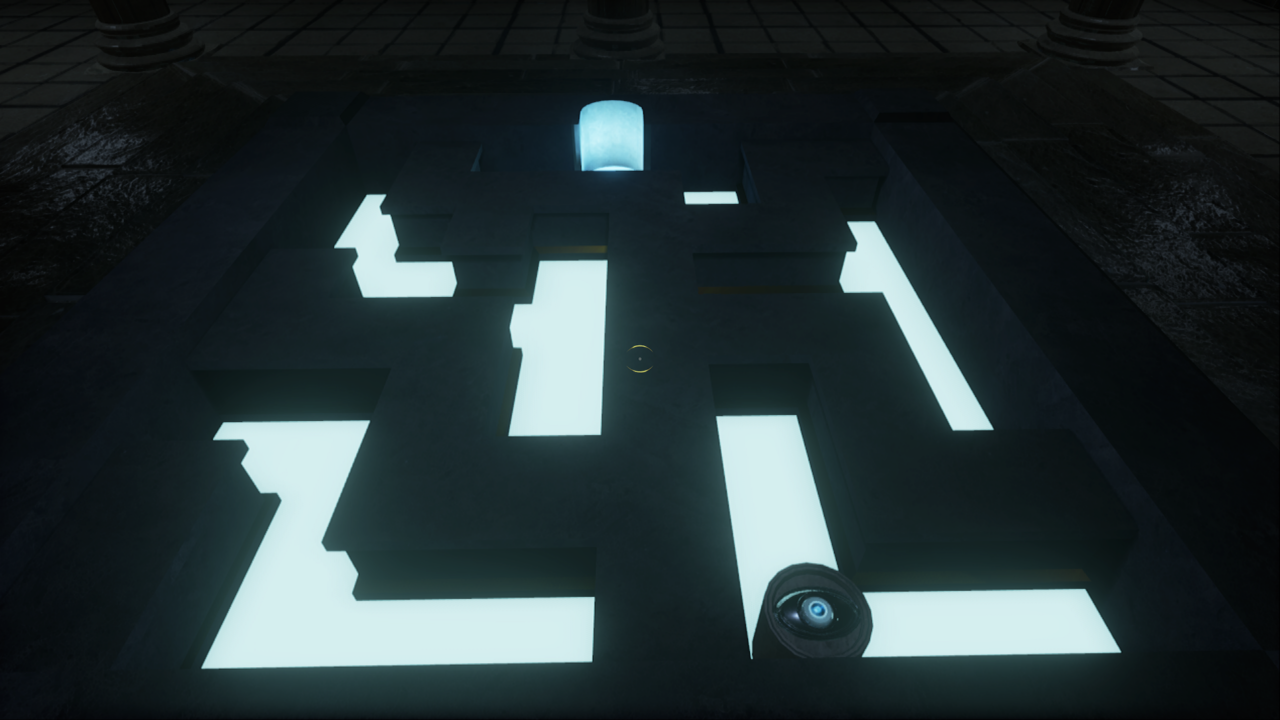
You can tell it's a puzzle game from the glowing eyes!
Despite the grandiose introduction, Pneuma is just a first-person puzzle game that reminds me pretty strongly of the Myst series - you're thrust into this world with no real setup (aside from the narrator's mostly inconsequential rambling), and your only focus is to push your way through.

As you progress through the stages, you'll uncover new puzzles with new mechanics, but you have to figure out how they all work through trial and error.  Nothing is every spelled out explicitly (at least, not in advance - there are a few places where the narrator will remark about something you just did), so you're left with your wits and details of the game world to make progress.

The Good

And honestly, that's awesome.

It adds an interesting element to the problem solving necessary to move forward - not only do you have to figure out the solution to each puzzle, you also have to spend time playing with it to learn how it works.

In some cases, the solution may be clear, but the way you manipulate the puzzle may not be.  Other times, the situation is reversed, and you'll find yourself struggling more to find the right path to the answer.

More eyes! But this one's in a little maze...
It's generally a nice change of pace from most modern games, and I really wish we'd see this kind of gameplay more often.

The Bad

Unfortunately, Pneuma isn't the best vehicle for this particular gameplay experience, and the major flaws come down into three big categories.

The first is the one that's least important - the narrator is exceptionally long-winded and the story tries way too hard.  The end result is that common monologues are really annoying, and the game's finale seems... blunt.  The developers clearly tried to do something interesting with the storyline, but it falls completely flat.  It was terribly executed all around.

Second, the game is incredibly short.  I completed it in about two hours, and because it's completely reliant on puzzles, there is zero replay value.  Obviously your mileage will vary depending on how quickly you pick up on each puzzle, but I imagine the majority of gamers will finish between one and four hours - not really worth the $20 price tag when compared to some other games on the market.

It wouldn't be a puzzle game of the modern era without a light beam puzzle.
Third and finally, the most damning flaw: most of the puzzles are relatively simple.  The developers had the freedom to change basic gameplay mechanics for each puzzle, which opens a huge range of potential interactions, but the game hardly explores that space of possibilities.  Most of the puzzles are fairly straightforward, and you can easily brute force your way through some of them that are not.  I was expecting larger, more complicated puzzles as I progressed, but that big payoff just never happened.  It reduces the game to a series of brief puzzles when it could have been so much more.

To be totally fair, there are a few optional puzzles that definitely qualify as "larger, more complicated puzzles," though it's easy not to notice that they're even there.  It just leaves this huge void between the single-step puzzles of the main story and the incredibly opaque optional puzzles.

Overall, Pneuma could have been an amazing game with a few more difficult puzzles to lengthen the whole thing a bit and if they'd just cut the narration.  As it stands, it's great if you're looking for a unique gameplay experience, but even so it provides relatively little bang for your buck.  It's definitely worth checking out if you can get it heavily discounted, but otherwise you're probably better off investing your time and money elsewhere.

My Rating: 5/10 - ok.

Sunday, February 14, 2016

GTASC 2016: Week 5 Report

Good God, the competition this year has been fierce.  We survived this week, but I worry about our long-term chances.

Regardless, here are the games that've been in my console this week:

Pneuma: Breath of Life - 1183 Points - I started the week with an interesting little puzzle game. While I enjoyed the gameplay quite a bit, the narrator is really annoying, and the whole thing is awfully short.  Still, it was good for over 1000 points in only a couple hours, so it helped me start this scoring period off right.

Just Dance 2014 - 194 Points - I'm a big fan of dance games right now because they give a nice opportunity for some exercise while contributing to the GTASC cause.  This week, I nabbed the achievement for getting 3 stars in each song.  The next big step of going to 5 is going to be tough.

Sacred Citadel - 486 Points - More Sacred Citadel as well.  I finished all the level challenges, which were more tedious than difficult, and knocked out a few other random things.  It's clear at this point that completing this game will just take time, as nothing about it is particularly hard.  Among the remaining time-consuming goals?  Playing through the entire game three more times.  Joy.

Double Dragon Neon - 404 Points - Because I haven't gotten my fill of beat 'em ups with awkward controls, I played through this one.  It's silly, which is easily the game's biggest strength, but that doesn't make up for the generally clunky combat.  There is some potential buried inside, so if you're willing to work past the initial frustration of coarse movement controls, you might have a fair bit of fun on the harder difficulties.

Dance Central 2 - 264 Points - More dance games!  I was getting tired of grinding the same songs over and over, so I popped this one in for a little more diversity.  Unfortunately, I'm a little disappointed with this game's soundtrack overall; it has some quality songs, but a lot of them are not things I'm really interested in playing.  We'll have to see how I feel after dedicating a bit more time to it.

On Friday morning, our team was in a pretty rough spot, already being below the elimination line.  As such, I whipped out some of the games I'd been saving that I knew could yield some points without too much effort:

The Raven - 529 Points - This game is essentially a terrible point-and-click adventure.  Maybe it's just a consequence of the Xbox's control scheme, but it blows my mind how incredibly frustrating this game is to control.  It's absolutely miserable.  And the storyline isn't all that interesting, either.  In short: stay away (unless you're desperate for some achievements, in which case, follow a guide and don't look back).

Velocity 2X - 1221 Points - Velocity 2X is easily my favorite of the games I played this week.  Nothing else even comes close to competing for that honor.  It's fast-paced action with awesome visuals and a high skill ceiling.  I'm really going to enjoy working towards the "perfect" medal achievements, even if it's going to be insanely hard.

Tomb Raider - Definitive Edition - 25 Points - I loved the Tomb Raider reboot from a few years ago, and I'm quite excited to play Rise of the Tomb Raider sometime soon.  Before that, though, I want to replay the previous game, so why not stack some achievements along the way?

As is tradition, I completed daily challenges for Magic Duels and Kinectimals Unleashed, too.  I also did some work in Neverwinter, chugging away at the various campaigns (including the new one that was released for the Xbox this week!).  More of the same for each of these, so not much to report.

Here's hoping next week is a little less stressful...

Tell me about what you've been playing recently!

Monday, February 8, 2016

Game Review - Polychromatic (Xbox One, 2015)

Even as games get more complex, there will always be a market for old school games where the only goal is to rack up as many points as possible.  Unfortunately, you can't just re-skin an early-80s arcade game and hope to have a quality product; you have to add something to your game to give it the depth or longevity necessary to compete for our money.


That's where Polychromatic misses the mark - there's nothing technically wrong with the game, but it lacks the depth to even make it worth the admittedly low $5 price tag.  Here's what it's all about:

The Basics

Without any fanfare, Polychromatic gives you control of a little square in a circular arena, and you can move around and fire bullets like any twin-stick shooter.  Your only mission is to survive by destroying all the other shapes that appear.

Woo explosions!

That's it.  That's the entire game.

To be fair, I'm exaggerating a little bit.  There are three game modes, though they are really just small modifications on the same formula (you're in the same arena each time, the only difference is that you only get one life in one mode, and you have a time limit in another).  You also have a couple special weapons, a dash that can rush through enemies and a blast that will fire bullets all around you, but those additions are pretty minor.

The game is honestly the most bare-bones twin-stick shooter that I've played in a long time.

The Good

Polychromatic's biggest plus is that it nails the aesthetics.  Everything is colored with soft pastels, and even your enemies exploding has a gentle feel to it.  And the soundtrack is nice.  It's borderline ambient music at times, and there's not a whole lot of diversity, but it's pretty mellow.  The whole thing makes for a surprisingly calming experience.

Aside from that, I guess the really basic mechanics are good?  You can get into a bit of trouble during gameplay because the explosions often obscure what the evil geometries are doing, but my deaths never felt cheap - it was always clearly my fault, which is ideal for this sort of game.

A selection of half the types of enemies in the game.

I know that's not exactly detailed praise, but there's not much to say.  In a game with simple controls and limited content, the sights, sounds, and fundamentals are really all that you can even talk about.

The Bad

And that is Polychromatic's biggest flaw.

I have no real complaints about anything in the game because there's so little actually in the game.  There are no powerups or point multipliers, there's only one arena to challenge you, and the three game modes are all identical in the way they play.  Hell, even the enemies are all pretty much the same, with varying movement speeds being the biggest differences between them.

It feels like I'm stuck commenting on the tutorial for a much larger game,

As you might expect, the result is very limited replay value.  Unless you're driven by a deep desire to reach the top spot on the leaderboard, there's nothing to encourage you to come back after your first handful of plays.  Contrast that with other similar games (Geometry Wars certainly comes to mind), and you'll find that Polychromatic simply can't compete even within its genre, let alone with much grander games.

Granted, it's only going for $5, so it deserves a bit of a leeway with some of my complaints.  Even so, I don't think it's worth your money because it's only marginally better than free Flash games from a decade ago.

If you're desperate for another game where you can outperform your friends on a leaderboard, you might give Polychromatic a shot.  Otherwise, you're better off investing those five bucks into something a little more expensive but worth significantly more.

My Rating: 5/10 - ok.

Sunday, February 7, 2016

GTASC 2016: Week 4 Report

Hoooooo boy.  This week was another scary one, though this time for good reason - going into the last 8 hours of the scoring period, we were about 100 points below the elimination line.  I busted out some of my quick-and-easy achievements to keep us above the threshold.  I think I've been a bit too conservative with my achievements,so it's probably worth pushing a bit harder in the near future.

Even so, here's what I was playing this week:

Neverwinter -  90 Points - Same as last week - grinding campaigns, not much else to say.  I did pop one achievement for completing one of the epic dungeons, but the others are still a bit beyond my reach (unless I end up with somebody who can carry me through, but those people seem quite rare).

Sacred Citadel - 381 Points - Sacred Citadel is the newest free "Game with Gold" for the 360, so I started that sucker up this week.  It's a pretty disappointing beat 'em up, where, among other things, it is far too easy to stun lock enemies (and be stun locked by them).  I played through every stage, so the only remaining achievements are going to be rather grindy affairs.  I'll probably work on that slowly over the next few weeks.

Far Cry 4 - 1241 Points - Oh, boy, Far Cry 4.  Despite having a favorable opinion of Far Cry 3, I hated this one when I started playing it last summer.  The driving mechanics are awkward, it's frustratingly difficult to trigger the on-screen prompts to interact with objects, it's impossible to engage in melee combat with enemies (because they always knock you down before you can connect), the map is huge and vehicles are surprisingly hard to find, and the random wildlife annoyingly gets in the way.  It's just not fun.

Still, I started it up again this week when a teammate wanted to try to knock out the coop achievements.  We weren't able to get those done (we can't connect to each other for some reason, despite being able to do coop with randoms online), but the effort inspired me to work on the single-player campaign.  I've now completed the story, so it's just a matter of cleanup from here.

Rare Replay - 373 Points - This was my "quick-and-easy" desperation move. In under half an hour, I earned nearly 400 points.  It would've been nice to save those for later, but the peace of mind they gave was totally worth it.  Here's hoping I won't have to whip something like this out again next week...

Magic Duels and Kinectimals Unleashed, too, though I (still) didn't earn any points in either this week.

But enough about me, what have you been playing this week?

Until next time, have a good one!

Sunday, January 31, 2016

GTASC 2016: Week 3 Report

I was a little worried nearing the end of this week, as we were only 1,000 points above the elimination line with about 6 hours to go.  I have to remember that we're still early in the competition, so the ~100 teams that were behind us weren't all going to blast ahead while I was asleep.

We ended the period 1,017 points above the line.  I really should not have been worried.

Anyway, here's what I worked on this week:

Neverwinter - 404 TA Score - Oh, boy, Neverwinter.  I hit level 70 at the beginning of this scoring period, which unlocked epic dungeons and three new campaigns.  I got achievements for some of the epic dungeons and skirmishes, but I still have a long way to go on that front, as the highest-level dungeons require my character to be a lot stronger than he currently is.  Plus I still need to get my secondary character up to level 70 as well.  I imagine there will be a lot of Neverwinter grinding in the next couple months.

The good news: this new content is a hell of a lot more interesting than the painfully repetitive "vigilance" tasks that got me from level 60 to 70.  It's hard, to be sure, but it's a lot more diverse, so it feels a lot less tedious.

The Walking Dead: Season 2 - 545 TA Score - Yeah, I know I'm way behind on this one.  I bought it back when it was new, but I never got around to playing it.  Figured it would be an easy way to get a few hundred points this week, and it definitely was that.

I'll admit: I wasn't really feeling the story through the first three episodes or so.  Yeah, I though Clementine's development was done really well, but it wasn't until the last third of the game or so that I truly got invested.  I ended up with a pretty good opinion of Season 2 overall, but it took a while to really grip me.

Just Dance 2014 - 283 TA Score - Big surprise, I'm sure - I kept grinding away at this one, earning 5 stars in a handful of songs.  I think I still have a decent ways to go, though I haven't actually counted up the number of songs I've completed (the in-game menu is atrocious, so it's a huge pain to check how many stars I've earned on each Classic routine).  I did, however, pop the achievement for burning 2000 calories, which came with a sizeable TA score.

Polychromatic -  1047 TA Score - More Polychromatic as well.  I knocked out the skill-based achievements with a little practice.  After that, it was just a matter of grinding out a bunch of points.  Overall not too bad of a completion.

I also realized this week that I've failed to mention a couple of the other games I've been grinding recently: Magic Duels and Kinectimals Unleashed.  I'm far from earning any achievements in either of these games, but I'm doing daily quests to keep inching closer.  Slow and steady.

That does it for this week's gaming on my end.  What were you playing this week?

Until next time, have a good one!

Sunday, January 24, 2016

GTASC 2016: Week 2 Report

Another week down, and 385 teams remain.  Here's what I was up to this week:

Rare Replay - 966 TA Score - This week, I focused on Atic Atac, Lunar Jetman, and Killer Instinct Gold.

Atic Atac and Lunar Jetman are older games like the ones I played last week, and they also aged terribly.  Lunar Jetman in particular is trash - really awkward controls and plagued with awful slowdown when too many objects are on screen.  It's all characteristic of the earliest video games, but it made grinding out the achievements a pain.  Granted, the in-game cheats make it doable, but it still sucked.

For Killer Instinct Gold, I just got the easy achievements for playing each game mode and playing as all characters.  I spent maybe 10 minutes in the game, which I'm putting off because I usually need a lot of practice to do decently at fighting games, and I'm not quite ready to make that commitment.

Neverwinter - 0 TA Score - More of the same grind, completing daily quests and slowly working to level 70.  No achievements this week, but I did sink a decent amount of time into it.

Just Dance 2014 - 146 TA Score - Also similar to last week's activity, but I managed to wipe up a few random achievements in this one.  The bulk of the points came from winning all the game's dance battles (which was pretty easy, to be honest), but I also kept working towards 5 stars on every song.

Polychromatic - 888 TA Score - Polychromatic is an old-school, arcade-style shoot 'em up, with all the usual pros and cons - it's challenging and can be exciting to continually push for a higher score, but it gets repetitive pretty quickly.  Still, this type of game is typically good for a decent chunk of TA Score, and while I still haven't earned the hardest achievements, over 800 points in about an hour-and-a-half of gameplay is a great contribution to my team.

And at that point, I stepped back as it seemed we had reached a safe score for the week.  We're still in the opening weeks of the contest, so we haven't reached the point where each scoring period will be a challenge.  Gotta keep pacing myself.

That's what I've been up to this week; what have you been playing?

Until next time, have a good one!

Sunday, January 17, 2016

GTASC 2016: Week 1 Report

It's finally 2016, so it's time for the next round of the Great TrueAchievements Score Challenge.  Teams are back up to four members this year, and Team Lazy Eye is looking to improve on last year's 75th percentile performance (our best one so far).

In addition to scoring as much as possible, I plan to write up little summaries of my performance each week, including brief descriptions of my thoughts along the way.  Mini achievement-oriented reviews in a sense.

Here's what I was playing this week:

Gems of War - 735 TA Score - Despite getting lots of praise, I was never a big fan of the Puzzle Quest formula.  Taking turns matching gems on the same board as your opponent encourages you to make matches specifically to prevent big combos instead of trying to set them up yourself.  It can lead to profoundly frustrating gameplay, as the random gems that refill the board dominate can create losses out of nowhere and some real feel-bad moments.

Gems of War doesn't really expand on that premise in any meaningful way, but it was a free game and reasonably mindless, so I got into it.  The downside?  It took me nearly 120 hours to reach level 100, which earned me the final achievement in the game.  It has a fantastic TA ratio (7.35), which is awesome, but it required many hours of mind-numbing grinding this week (and in the weeks prior).

Neverwinter - 176 TA Score - Neverwinter is a pretty reasonable MMORPG, especially for a free console title.  The latest updates have added some pretty disappointing content (unabashedly repetitive questlines, for one), but it's good for some serious TA Score if you can dedicate the time to grind up in levels.

Most of what I've done with Neverwinter this week was daily Guild quests to farm Guild Marks, Along the way, I completed 10 normal dungeons and finished killing the required number of giants and trolls to earn three achievements.  Not huge, but my main character is tantalizingly close to the level cap, which will unlock a lot more content and allow me to nab several more achievements.  Looking forward to that in the next few weeks.

Rare Replay - 1708 TA Score - This was the big one this week.  A collection of a ton of classic Rare games (though sadly not the most iconic Rare games in my mind, the Donkey Kong Country series, for obvious trademark reasons), Rare Replay has a lot going for it.  To be totally honest, though, a lot of the early stuff hasn't aged very well at all.  Even so, I'd definitely say it's worth the investment.

On the achievement front, I focused on Snapshots (little challenge levels specially designed for the older games), Gunfright, and Snake Rattle N Roll.

Gunfright and Snake Rattle N Roll are both perfect examples of games that haven't aged well, but the save and rewind features make the achievements for those games trivial.  They're not terribly time-consuming, either, as I spent less than 2 hours on each of those games.

Snapshots can be very challenging, as you can't save or rewind, so you have to do it all legit.  Still, with some practice (and occasionally a good guide), I was able to knock several of them out this week.

Just Dance 2014 - 9 TA Score - I've been a fan of rhythm games since I first played DDR back in high school.  The more recent motion-sensing dance games scratch that same itch, albeit in a different way.  Another upside of Kinect games is that they typically have pretty inflated TA Ratios, so they're great for a competition like the GTASC.

This week's achievement was just liking a dance video that somebody uploaded, so it required minimal effort (for a surprising Ratio of 1.77), but I also worked on earning stars, inching closer to the achievements for earning 3 and 5 stars on all songs.

And that was it for this week.  The GTASC is a marathon competition, as it lasts all year, so I'm trying to pace myself a bit.  As a result, I've spent a lot of time grinding towards big achievements instead of rushing full speed ahead.  Looking forward to an epic performance this year.

Anyway, that's what I've been up to this week, what have you been playing this week?

Until next time, have a good one!

Thursday, December 24, 2015

Game Review - Lifeless Planet (Xbox One, 2015)

Video games can provide experiences that no other medium can because of player interaction.  The best books and movies can tap into the audience's emotions, but the mere act of guiding a character generates enough investment in the narrative to drive deeper than a film ever could.  Lifeless Planet is a prime example of this sort of game.


In fact, it is one of the best storytelling games I've ever played.  While some games let you overcome complex challenges or beat your friends in a head-to-head match, Lifeless Planet provides a brilliant stage for exploring the world its developers created.  Therein lies both the strongest and weakest features of the game, but I'll get to that in a bit.

The Basics

Lifeless Planet opens with an astronaut making the first trip to a planet 30 light years away.  Unmanned probes have indicated is full of plant life with an oxygen-rich atmosphere, but when the astronaut crash lands, he discovers it is actually barren and hostile.

Yep. Chock full of life.
From there, he desperately searches for answers and a way home.  The path ahead is riddled with small puzzles and platforming sections, but for the most part, the emphasis is on exploration - looking for clues and finding minerals and other objects that suggest something about the planet's history.  Each discovery brings new questions, leading to a more complex narrative than you might initially expect.

The Good

And that narrative is amazing.

As I played, I kept thinking that the story was ripped straight from a Twilight Zone episode.  The desolate world provides the perfect backdrop for that kind of reality-questioning vibe.

More impressively, that tone persists throughout the entire game.  After one piece of the story fell into place, my focus shifted seamlessly to another part of it - "ok, so that's how that happened, but I still don't know about this other thing.  Maybe it's this."  This process continued for the 9 hours or so that it took for me to complete the game.

Large structures make an appearance, too. Hmm.
And at the end, I still had questions.  That lingering uncertainty about key story elements often makes for an unsatisfying conclusion, but for Lifeless Planet, it still felt like all the necessary bits were wrapped up.  The story was told, but it gave brief insight into a fascinating world, which left me digging for more answers.

In short, Lifeless Planet succeeds in telling the kind of story that is usually reserved for the best science fiction.  It's awesome.

The soundtrack also plays a crucial role in setting the tone.  While the game is usually quiet, some bits of music will occasionally pop up to enhance the tension of a particular scene.  It's done really well, and it further complements that Twilight Zone feel.

And... desks?


The Not-So-Good

For Lifeless Planet, I don't think it's quite fair to list "bad" features, as nothing is overly negative.  There are, however, a few things that could be a lot better.

An obvious one is the graphics.  While they did a great job of conveying the isolation of a lifeless world, there are some places where simple textures undermine what could have been breathtaking structures or objects.  Similarly, there are a few cutscenes featuring human beings, and they look pretty bad.

These graphical issues aren't enough to detract from the overall experience in a significant way, but there's some lost potential in making the game even more engrossing.

Time to jump!
The real frustrations come with the gameplay mechanics, though.  Unlike most games I've played, your character actually conserves momentum when jumping - once you're in the air, you can't change your direction or speed.  While nice from the perspective of presenting some realism, this is definitely a place where I think realism should be sacrificed for good gameplay.

The reason?  It can be really easy to misjudge jumps, and I often found myself having difficulty getting up to speed on small platforms.  It led to me failing a number of platforming sequences where it felt more like the game was screwing me than a lack of skill on my part.

Another problem lies in some of the dark sections of the game.  When night falls, you'll understandably need to use a flashlight to get around.  The issue is that your flashlight isn't very powerful, so your sight is limited enough that the platforming can be nearly impossible.  Finding the next platform is a big challenge, and it's far more frustrating that fun.  I spent well over 10 minutes stuck in one area, jumping every way I could (and dying) in a desperate attempt to find the next platform.

I'm just saying that the few dark sections are either poorly designed or should be a lot shorter - or both.

Despite these criticisms, Lifeless Planet provides an unparalleled experience.  If you're a fan of classic science fiction or you're looking for a fantastic story of isolation and confusion, you should absolutely check out this game.  If you're more likely to get invested in the gameplay, you might be better served elsewhere.  I still highly recommend it, though.

My Rating: 8/10 - great.

Tuesday, December 22, 2015

Game Review - Beatbuddy: Tale of the Guardians (Xbox One, 2015)

Despite developers' best intentions, a lot of games lean very heavily on one of their major features: a fun mechanic, a compelling story, or a beautiful setting.  Beatbuddy: Tale of the Guardians falls solidly into that last category, with amazing aesthetics but lackluster gameplay.  Let's just get into it:


The Basics

In Beatbuddy, you play the titular character as he works to save his aquatic world, Symphonia, from... something.  Honestly, the plot wasn't very clear to me until near the end of the game.  All you know at the start is that somebody is trying to "take the temple" and "control the music," which is apparently a terrifying proposition.

A gate, a submarine, and a little blue dude.
To accomplish this goal, Beatbuddy will have to navigate strong currents, break down barriers, and activate switches.  It's essentially a puzzle game, where figuring out how to get from A to B is usually more challenging than actually doing it.  As the game progresses, there is an increasing emphasis on fairly simple combat (you can punch and dash and that's it), but it is relatively minor even in the final stages.

The Good

This game is absolutely gorgeous.  Each of the game's six levels has a unique feel to it, and every detail is fantastic.  The art style and implementation are amazing, and it's generally a pleasure to look at.

Look at that big, dumb fish!
The soundtrack is similarly fabulous.  Each stage features a single prominent theme woven throughout it, and that music is integrated into the gameplay itself.  While this integration isn't terribly clever, as it's mostly just objects pulsing with the beat and a few rhythmic punch combos, some on-screen features affect the music.  For example, when certain types of creatures are on display, bass drums or hi-hat cymbals may be emphasized.  It's kind of a minor feature, but it makes for a surprisingly dynamic experience.

And that's the best thing I can say about this game: it's a great audiovisual experience.  Fantastic music paired with a charming world does a lot of work.

But that's it.

The Bad

Everything else is mediocre at best.

I don't think it's entirely fair to criticize the tissue paper thin storyline, as that's obviously not the focus of the game, but they put enough into it for the plot to be disappointing.  There are many brief bits of dialogue, but they don't do anything except distract from your exploration.  It doesn't quite reach the point of being frustrating, but the game would be better without such a feeble attempt at a narrative.
Because a game can't exist without some attempt at story these days.
The biggest problem, though, is that the gameplay is incredibly shallow.  For what seems to be a puzzle game, just about every obstacle you encounter is pretty straightforward, so it's pretty mindless.  The biggest exception is a puzzle that involves switches opening and closing various gates, but this puzzle spans several screen-lengths.  It's "challenging" because you can't see which gates each switch opens without swimming around the whole area, so it feels like a terrible design more than anything else.

To be fair, little to no challenge is not necessarily a problem.  With such fantastic aesthetics, the simple act of exploring the world could be reason enough to play the game.

Except that there's very little to explore.  I completed the full game in about 3 hours, and I don't feel any drive to play through it again because there's absolutely nothing to look for off the main path.  There are some collectibles, "beat points" that unlock concept art and the like, but they're mostly in little caches here and there.  There are never multiple pathways or side areas; everything in the game is a piece of normal progression.

The pipe organ of the sea.
The combination of linear worlds with few challenges but awesome presentation makes the game feel almost like a glorified slideshow.

And I think that summarizes the experience quite nicely - shallow but pretty.  With more entertaining gameplay, Beatbuddy could have been one of the best games of the last few years.  As it stands, though, it's probably not worth the investment, but you're not setting your money on fire if you decide to give it a shot.

My Rating: 4/10 - mediocre.

Monday, December 7, 2015

Game Review - Fallout 4 (Xbox One, 2015)

Fallout is easily one of my favorite game franchises.  Its setting in a post-apocalyptic retro-future is perfect for a unique and exciting world to explore, and the lore behind its nuclear wasteland is just bizarre and creepy enough to make every discovery fascinating.  Plus the games are built upon a solid RPG foundation, so the series is tons of fun in many respects.

Five years after New Vegas, Fallout 4 is finally here, and it brings the biggest world of the series.  It isn't without flaws, but it certainly gives a better exploration experience than any of its predecessors.

The Basics

Fallout 4 opens a bit differently than the previous entries of the Fallout series - the protagonist and his or her spouse prepare for an evening at a veteran's hall before the nuclear war that gives the franchise its name.  Shortly after settling on your character's appearance, their small family (infant included) are ushered to nearby Vault 111 just before the bombs hit.

Plus you get to see the bombs hit. It sets a somber tone in a way that no other Fallout game has.
Once inside, they're cryogenically frozen to be reawakened once the surface is safe again.

Of course, that doesn't happen as intended.  Instead, your character is abruptly awoken long enough for their spouse to be murdered and son to be kidnapped.  You unfreeze permanently some time later (roughly 200 years after the nuclear war), with only one obvious objective: find your son.

The core of what follows is very similar to the previous 3D Fallout games - lots of characters to meet and locations to discover, with first-person shooter combat supplemented by the statistics-driven VATS system, which allows you to pause the action and target specific enemies and body parts for a more strategic experience.

If you've played either Fallout 3 or New Vegas, you know how the basic mechanics feel.

The Good

The absolute best feature of Fallout 4 is that the world is huge.  There are well over 250 distinct locations to discover.  While some of these locations are just major landmarks without much to explore or discover, it's still a whole lot to see and do.  To give some perspective, I had logged 70 hours on one character by the time I finished the story, and there were still a handful of side quests and unexplored areas I hadn't visited.

Even better: this post-apocalyptic wasteland is surprisingly gorgeous.  Yeah, the dilapidated buildings and urban debris are aesthetically very repetitive, but the world outside is just stunning.  I think a lot of it comes down to diversity - instead of being a bunch of washed out browns and grays, there's quite a bit of color scattered around.  The weather is also fairly dynamic, with fog and rain occasionally breaking the monotony, and the sky makes the game feel impressively open.

Seriously, look at that!
The size and beauty of the world make for an amazingly fun and inviting world to explore.

In terms of mechanics, not a lot has changed from previous titles in the franchise, though that's not a bad thing.  VATS still lets you play the game essentially as a turn-based RPG if you wish, or you can run and gun like a first-person shooter, and both options are reasonably well done.  Nothing groundbreaking on the combat front, but it's good enough to keep things interesting.

There are, however, a couple noticeable mechanical changes, and I think they're both for the better.

First, the perk/leveling system is a bit more streamlined.  In previous games, you would begin the game by assigning your starting attribute points, choosing primary skills from among a dozen or so options, and then obtaining special perks every couple of level ups.  It's a good system to be sure, as it allows a lot of customization and nuance.  At the same time, though, this system puts a lot of emphasis on knowing the game - some skills are just less useful than others due to what's actually in the game, and choosing perks could be tricky for similar reasons.

Fallout 4 removes those skills entirely, integrating their functionality into the perk system instead.  This time around, you get a new perk each and every level, and perks do everything from increasing your damage with certain types of weapons to unlocking new crafting options.  Yes, you lose some of the game's complexity, which will be a disappointing change for some, but I think the gain in more accessibility (and fewer feel bads if you invest skill points into something borderline worthless) is worth it.

Plus perks are now in a handy dandy table, making it easy to see your options.
Speaking of crafting, the second major change is that the system for using resources to make new goodies is substantially more robust.  A lot of that change has to do with the new build mode, which allows you to make structures and defenses in some friendly encampments and recruit new allies.  But on top of that, there are tons of recipes for consumable items and gear modifications to let you become exactly the kind of killing machine you've always wanted to be.

The biggest benefit of these expanded crafting options is that all the random crap you find is actually useful.  Every "junk" item in the game can be scrapped for raw materials, so you might actually find yourself scrounging for hot plates and oil cans as you clear buildings and bunkers.

There are, of course, other good features of the game as well (like the fact that you can loot containers without having to "open" them), but that covers the biggest ones.  As much as I want to continue singing the game's praises (I am a big Fallout fan after all), there are a number of disappointing features as well.

The Bad

The biggest problem is one that seems to plague a lot of games these days: loading screens are atrocious.  Each individual load screen may take 10-20 seconds.  That's not oppressive in the abstract, but when you're trying to quickly travel from, say, one town to another, there could be three or four of these loading screens in your way.  The fast travel system doesn't feel so fast when it takes a minute of waiting or more to reach your destination.

Loading screens aren't much of an issue when you're in full exploration mode, but it can get awfully frustrating when you're trying to buy ammo or turn in a quest or something of the sort.

Ghouls!

The other big disappointment is embedded in the main storyline missions.  As is typical of a Fallout game, there are several factions with a vested interest in the game's major events.  Unsurprisingly, these factions are at odds with one another, all fighting over the same resources to push their own agendas.  Even better, there's no obvious "good guy" in this particular conflict; each organization brings their unique biases and whatnot.  That moral ambiguity is great!

Unfortunately, as far as I could tell, there's really only one way to progress through the story - with brute force.  There's no sneaking around and sabotaging, there's no convincing a faction to lay down their arms.  You can't talk faction leaders out of using violence as an answer to their problems, so the only way to influence the story is in the faction you choose to join.

And that is really disappointing and frustrating.  A pure intelligence/persuasion build is impossible to pull off, as you are forced to deal with big firefights throughout the game.

For a lesser complaint, given the sheer size of the game, it's a little disappointing that there aren't many new species to discover (and brutally murder).  It's basically the same menagerie as before - humans, supermutants, ghouls, mirelurks, and bugs.  There are a few new strains of mirelurks, but that's it for new and unusual fauna.  A missed opportunity in my mind.

Including the intimidating Mirelurk Queen.
Sadly, the in-game music falls in the "bad" category as well.  You have a couple radio stations to entertain you in the wastes, but many of the songs were included in previous games.  I guess it fits with the world building a bit because radio stations around the country have the same pre-war popular music, but it has definitely gotten old.

Ambient music, on the other hand, is actually pretty good, so I guess it's not all bad.

One more complaint: the town-building aspects of the game, while cool, have some problems.  The first is just that moving and placing items can be a huge pain given the perspective of the game and the lack of a strict grid (or something similar) for guiding placement.  That process can get quite awkward and frustrating.

The second is a bit more significant.  There are mechanics for measuring the happiness of people in each of your allied settlements.  Unfortunately, those mechanics are either glitched or unintelligible, as it seems impossible to make people happy for an extended period of time.  I'm not sure if their dissatisfaction affects anything else in the game, but it's annoying nonetheless.

(Full disclosure: the base-building in the game isn't really my thing, so I spent an hour or two on it and moved on.  Despite those flaws, there's a fairly impressive system in place, so you may find it to be a ton of fun, if you're into that sort of thing.)

The Summary

If you're a fan of the lore and atmosphere of the Fallout franchise, Fallout 4 is amazing because it gives you a huge world to explore.  The game does a decent job of letting you develop a character and use him or her to dominate your enemies, if you're into that sort of thing instead.  But if you loved the open-endedness of the interactions in previous Fallout games, you'll probably be disappointed by this one.

Still, it's definitely worth playing if you're RPG fan.

My Rating: 8/10 - great.

Thursday, October 29, 2015

Game Review - Whispering Willows (Xbox One, 2015)

I love adventure games, but they're hard to get right.  The quality of such a game comes down to its storytelling.  Adventure games can focus on developing an exciting universe to explore because that's all they do - the gameplay focuses on learning about the world, so an adventure game thrives or dies on the back of its world building.


Whispering Willows comes so close to presenting a truly enthralling world, with a beautiful art style and a decent hook, but it just misses because the story isn't quite up to snuff and the puzzles aren't very puzzling.  Here's what you can expect:

The Basics
Whispering Willows opens with one of the most rapid-fire cinematics I've ever seen.  Elena, the game's protagonist, wakes from a nightmare showing her father in danger and runs to a dilapidated mansion looking for him.  She quickly learns that her father's amulet, which she was naturally carrying with her, grants a unique power - with it, her spirit can leave her body and explore the nearby area, able to speak with other spirits along the way.

From there, Elena must uncover the history of the mansion and its occupants to find her father and, well, save the day.

The Good
That's probably one of the less enjoyable ways to go...
First off, the game looks fantastic.  The animation and art style are both nearly perfect, giving a great level of detail to the areas you'll explore and the spirits you'll meet.  In fact, one of the coolest features is that you can see how people died by examining their disembodied spirits - mangled bodies and severed limbs tell stories on their own.

The "changing forms" mechanic is also pretty cool, as it gives each area two layers of possible exploration.  It isn't exploited very much, but it was neat to have both options.

The Bad
Unfortunately, the list of the game's misses is quite a bit longer.

The biggest flaw?  Your first playthrough can easily be completed within 3 hours, and that includes a fair amount of wasted time fumbling around while looking for the next piece of a puzzle. On top of that, there is absolutely no replay value (once you've figured everything out, there's nothing left to do), so you're looking at a game worth only a couple hours of entertainment.

To be fair, a short game can still be mindblowingly good (the original Portal comes to mind), but the story doesn't have nearly the depth necessary to pass that threshold.

Yep, those are nasty, zombified arms. I'd imagine it smells pretty bad, too.
Another big problem is that there aren't really any true puzzles.  With three exceptions, every task in the game is essentially a fetch quest - you only need to find the next relevant item (which is always just sitting somewhere) to keep going.  You don't have to dive into the lore to figure out where something is hidden or piece together multiple characters' stories to find the solution to a riddle.  Of the three challenges I'd consider puzzles, two are almost trivial, and the third is frustrating in that it doesn't work quite the way I expected (though it's still very simple).

Basically, the gameplay lacks that integration into world building that makes the greatest adventure games good.

Finally, the story leaves quite a bit to be desired.  It's told almost exclusively through diary pages you find scattered throughout the game.  There's nothing wrong with that particular format, but it's pretty poorly written - probably 80% of the text is written using simple sentences, so it feels very dry and monotonous.  That simplicity in writing also means that none of the characters have different voices, so there's nothing distinguishing about the way various characters speak or write.

Suiting up.
The plot itself is fine, and I had fun trying to figure out what was going on along the way.  I think some of the major points were a little more obvious than the developers intended, but it was still decently interesting.  With better writing, though, it could have been so much better.

One final complaint: the game is riddled with unusually long loading screens.  Given that it's not graphically complex, it is downright shocking that it can take up to 10 seconds to transition from one small area to the next, and there are so many of these transitions that loading screens make up a decent chunk of the 3-hour game time.

The Neutral
Sound quality is really the only thing I haven't mentioned, and it's... fine.  The opening theme is appropriately eerie and evokes a nice supernatural feel, but nothing beyond that really stands out.  It's good enough not to detract from the experience, but it doesn't enhance it, either.

And I don't have much else to say about Whispering Willows.  If you can get the game on a dramatic sale, it might be a decent introduction to adventure games for novices of the genre.  Otherwise, it's probably best to avoid it.

My Rating: 3/10 - bad.

Thursday, October 22, 2015

Game Review - Final Fantasy Type-0 HD (Xbox One, 2015)

Every longtime gamer has ample experience with the ever-growing list of cardinal sins of game design.  The most recent addition may be invasive microtransactions, but the classics are still a problem: awkward escort missions, forced level or item grinding, unskippable cutscenes, and the like.

It seems like the developers of Final Fantasy Type-0 randomly picked some of these terrible design elements and built them into their game.  Type-0 is rife with such moments, with tedious segments outnumbering the admittedly fun action RPG missions.


In short, Type-0 is baffling and frustrating.

If you're interested in hearing why it's such an annoying game, read on.

The Basics
Type-0 is absolutely not what I would have expected from a game bearing the "Final Fantasy" name.

It opens in the midst of a full-scale invasion - the Militesi Empire bears down on the Dominion of Rubrum, and the fight appears to futile.  This cinematic sets a somber tone, as corpses litter the streets and the first character to speak slowly dies in a pool of blood.  I can't remember any other Final Fantasy cutscenes that even approach this level of intensity.

You then take control of a few members of "Class Zero," an elite group of 15 Dominion cadets tasked with precision missions - the Dominion's "Special Forces," if you will.  As you repel Imperial forces, you learn that the Empire's initial dominance was due in part to magic-inhibiting crystals that bizarrely didn't affect your party.

Oh look, most of the characters are named after playing cards. Cute.
As with most games, this introductory mission sets the stage for both the story and the gameplay.

What follows is a game broken into three basic categories - action missions, real-time strategy missions, and exploration and side quests.  It is unlike typical RPGs in that these three elements are completely distinct; you cannot blend objectives together, as you can only take on one side quest at a time, and you must complete side quests before tackling the next mission.  In this sense, Type-0 feels much more like a series of levels than a real RPG experience.

The action missions make up the bulk of the game.  Before each one, you will choose which of your cadets will join the "reserve" forces, and then you'll pick three to be your primary party.  As characters fall in combat, you can call in reinforcements from your reserves, making for dynamic battles.  Like many games these days, pulling up the menu doesn't pause the action, so you have to be quick with item usage in the midst of battle.

That Trooper is screwed.
During these action missions, you control one of your active characters (though you can switch between them at will), running around the battlefield and executing up to four unique abilities, each of which are bound to a face button on the controller.  While this setup restricts your in-game abilities somewhat (no complex combat system here), there is a fair amount of customization that goes into your preparation for battle - you can unlock a ton of skills for each character, and you get to choose which four they'll take on each mission.

RTS missions are sprinkled in occasionally, though they are usually skippable, which is kind of nice.  Similar to action missions, you'll select a group of cadets for your reserves, but this time, you'll choose one active character to run around the world map.  While there, allied and enemy towns and encampments will spawn units and send them towards another outpost.  When opposing units meet, they'll fight to the death, and units approaching towns will attack to lower stationary defenses.

Using your character, you can fight enemy units to open windows for allied units to invade an outpost, or you can issue orders to a friendly encampment instructing them to make different units or send those units to a different destination (sometimes. I couldn't quite figure out what circumstances would allow me to issue these orders).  Once your units deal with a major city's defenses, you can then invade that city, transitioning to a brief action mission sequence.

Issuing orders for global domination.
All things considered, Type-0 has some interesting mechanics, but the execution is questionable at best.  Let's start by looking at some of the game's problems.

The Bad
I think the biggest and most consistent problem with Type-0 is the storyline.  Like most Final Fantasy games, it leans heavily on exposition in various cinematics, but the story is much too convoluted to be truly gripping.

Here's the problem: you have 15 main characters right from the start.  Fifteen.  This means that there is virtually no opportunity for character development, so it's hard to get invested in the conflict.

On top of that, there are dozens of secondary characters, most of which are also not given substantial screen time.  In addition to the Dominion and the Empire mentioned above (and to be honest, it took me an embarrassingly long time to figure out which was which), there's an Alliance and a Kingdom, and it's rarely clear who comes from which organization.

To give a more concrete idea of the problems here, I had no idea who was friend or foe for at least half the game.  The brief appearances by generals and politicians all set off my "bad guy" detection, and they throw proper nouns around all the time.  There are dozens of relevant characters, locations, and stories, but it's all dumped on you so rapidly and with so little explanation that it's damn near impossible to keep up.

And to top it all off, the final chapter comes completely out of nowhere.  The first 30 or so hours of the game all lead up to a climax that fizzles out in favor of something else entirely.

If I had to summarize the plot in one word: baffling.  It's just terrible storytelling.

The gameplay is a bit better but still has significant flaws.

The RTS segments are miserable.  You move uncomfortably slowly on the world map, so the entire thing feels sluggish.  It can also get frustrating as quick movements could often allow for clean sweeps of enemy bases, but you instead fall behind because you couldn't bolster allied units on the other side of the conflict.  Add the previously-mentioned unapparent conditions for issuing orders, and you end up with a frustrating mess of what could have been a cool minigame.

Why allied units are tinted red is beyond me...
Exploration and side quests are another great source of frustration.  I mentioned above that you can only take on one side quest at a time (seriously?), but the worst part of these inter-mission sequences is that they are timed: you're only allowed a certain number of interactions (including little conersations with NPCs and leaving the main town).  Putting that kind of restriction on exploration really dampens it; you have an incentive not to thoroughly explore the game's world.  Neutering exploration and discovery that way killed my desire to investigate the world.

Another problem with the intermissions is that many of the side quests are way harder than the main missions.  Yeah, some of them are called "Expert Trials," but they sometimes come with recommended levels 20 or so higher than the following story mission.  Perhaps those missions are intended to be challenges for your New Game+ playthrough, but their presence in your first go is offputting - it either feels like you're not able to access a decent chunk of the content, or it pressures you to power level.  Neither of those scenarios feels particularly good.

In fact, if you don't spend time grinding out levels between story missions, you may find yourself woefully underleveled.  The game features a particularly nice way of leveling up, which I'll get to in the "good" section of the review, but feeling like you have to grind to continue is always miserable.

I took about 35 hours to complete the game; roughly 10 of those were dedicated to grinding levels so I could progress.  I imagine you can see the problem.

For the record, Mog is only moderately less annoying than Navi.
For all the other problems, the action missions are pretty solid.  The lock-on mechanic and controlling the camera can be tricky to master, but that's pretty standard with third-person action games.  Battles can also start to get somewhat repetitive, but it's not the worst thing in the world.

Unfortunately, the list of good elements of Type-0 is quite a bit shorter.

The Good (Or Good Enough)
Camera issues aside, the action missions are decent fun. While overwhelming from a story perspective, the abundance of characters makes for a fair amount of diversity in gameplay.  Each of the 15 protagonists wields a different type of weapon and has different magical capabilities, so you get some customization by choosing the character that best fits your playstyle.  It can be exceptionally frustrating when your preferred character dies on a mission, but it's a nice angle nonetheless.

Another cool mechanic is the "killsight."  Sometimes, while locked onto an enemy, they will have an icon appear on top of them, usually during or just after they execute an attack.  If you manage to land a hit while that icon is on screen, you will immediately dispatch weaker enemies or deal massive damage to larger ones.

These killsights add a bit of ebb and flow to combat; instead of wailing indiscriminately, you are often better suited to time strikes to maximize damage.  The timing windows are often fairly narrow, which can be tricky with some of the slower characters, so there's a bit of a learning curve to get it all right, but it gives the fights a fun vibe overall.

To mitigate some of the misery of the repetitive grinding, you can replay missions from the main menu at any time.  Any items or experience you accumulate on those replays will persist in your save file, so you're not trapped balancing the between-mission timer with your attempts to avoid unspeakable defeat in the next mission.  It's annoying that such a leveling system is necessary, but it's better than any alternative.

And honestly, that's it when it comes to gameplay.  Lots of other ideas are kinda neat (like the RTS missions), but they're so poorly executed that I'm not sure if anything beyond the concept is worthwhile.

Mid-cinematic. Look at those textures!
On the superficial end of things, the audiovisuals are... ok.  The HD version of Type-0 is a remastering of a PSP game, so it's not surprising that the graphics aren't groundbreaking, but they aren't particularly chunky or garish, either.  The soundtrack is pretty good, with a few sweet tunes along the way, but nothing overly memorable.  And the voice acting is acceptable.  Each of the main characters has a fair amount of, well, character, but again, they're so poorly developed that there's not much of an opportunity for an awesome performance.

And that's it.  Type-0 doesn't even feel like a bunch of failed potential, it just seems like a ton of design mistakes that distract from otherwise decent primary gameplay.  I can't really recommend it because it requires a huge time investment for only minor returns in entertainment.

My Rating: 3/10 - bad.